Shattered Pixel Dungeon
- 4.8
- Rating
- 5.00M
- Installs
- Free
- Price

 Analysis by App-foxy
I expected a lightweight role-playing game when I installed Shattered Pixel Dungeon, but its simple presentation hides a game that asks for careful decisions almost immediately. Developed by Shattered Pixel, this free roguelike dungeon crawler is easy to start and much less forgiving once the dungeon begins to test your choices. I found that contrast to be its main appeal: the controls and basic objectives are approachable, while survival depends on learning how movement, equipment, enemies, and limited resources work together.
The game is available for free and carries an Everyone 10+ content rating. It has been around since September 15, 2014, and its popularity is easy to understand after a few runs. The store shows a 4.8 average from roughly 171 thousand ratings, with more than 5 million installs. Those figures do not replace personal experience, but they match what I felt while playing: this is a focused game with a strong audience, not a disposable dungeon-themed time filler.
What the first run really feels like
The first thing to understand is that this is not a conventional role-playing game where you steadily build one hero through a long, safe campaign. Each attempt sends you into a dangerous dungeon, and a failed run means starting again. That structure can sound harsh, especially if you normally prefer games that let you keep every upgrade forever. In practice, I found the repeated attempts useful because each defeat taught me something specific.
You May Also Like

 Blood Strike: 2.5 Anniversary
Blood Strike’s Loadouts Turn Every Drop Into a Tactical Gamble
A close look at Blood Strike’s custom loadouts: how fast access to signature weapons reshapes its battle royale rhythm, rewards preparation, and narrows the gap between fights.

 Pandora - Music & Podcasts
Pandora’s Music Is Easy to Start, but Harder to Recover
Pandora’s strength is its low-effort path from a seed to a station. Its weak spot is how much confidence it asks you to place in connection, setup, and quiet recovery.

 8 Ball Pool
 Is Built on Rivalries, Rematches, and Routine
A close look at the rivalries, rematches, shared routines, and unanswered safety questions that turn a quick pool match into a persistent mobile community.

 Samsung Music
’s Quiet Strength Is Playing What You Already Own
Its reach comes less from spectacle than from dependable access to a personal library. That simplicity is both the app’s strongest retention engine and its ceiling.

 AccuWeather: Weather Radar
AccuWeather Review: A Quick, Clear Forecast for Everyday Decisions
For everyday plans, the best forecast is the one you can understand quickly. AccuWeather makes rain timing, radar, and local conditions easy to act on, with a few trade-offs.

 Hill Climb Racing
Why Hill Climb Racing Still Turns Crashes Into One More Run
A tiny car, a bumpy hill and one more upgrade: Hill Climb Racing keeps resurfacing because its simple chaos makes every near-miss feel personal.
More From Our News Desk



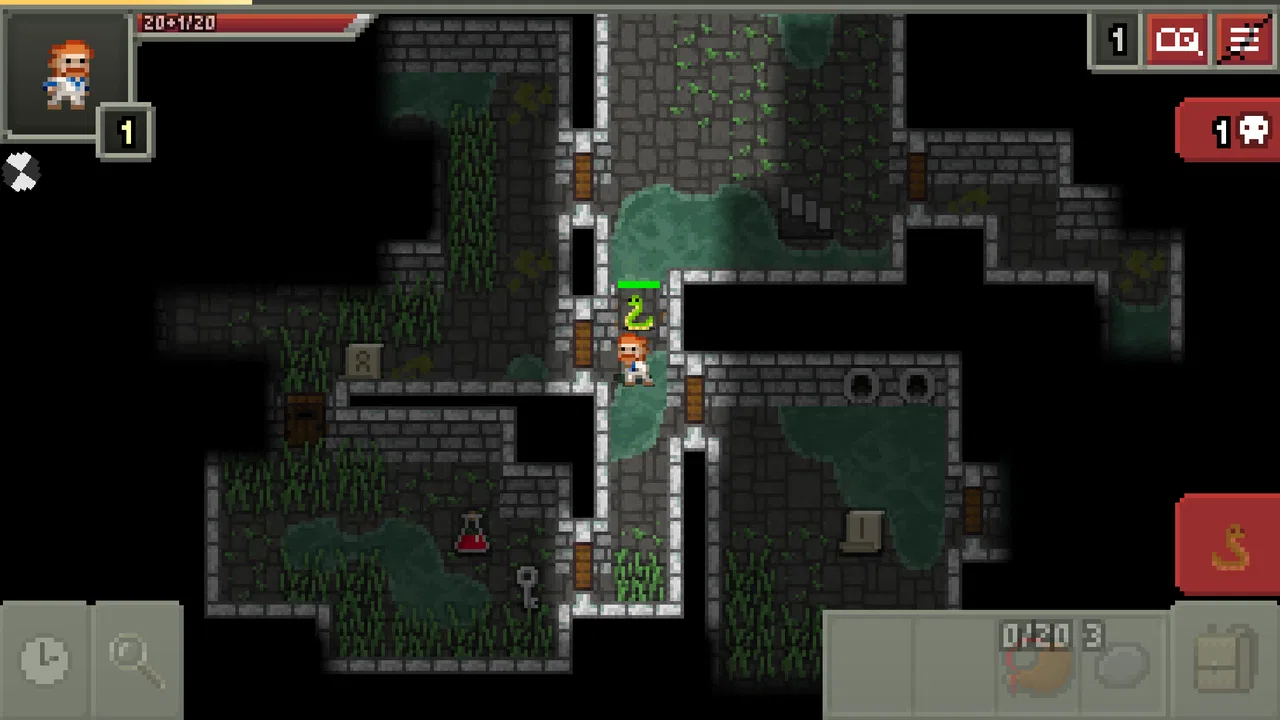
The game uses a compact, grid-based view that makes every step meaningful. You move through rooms and corridors, inspect what is around you, fight enemies, and decide when to use equipment or consumable items. The interface is not overloaded with animated menus, so the focus stays on the next decision. That makes it comfortable for short sessions, although the turn-based rhythm can become surprisingly absorbing when you start thinking several moves ahead.
My first useful adjustment was to stop treating movement as harmless. Walking toward an unexplored area can expose the character to an enemy, a poor position, or a situation where retreat becomes difficult. I began pausing before each doorway and checking whether I had enough health, room to maneuver, and a sensible escape route. This small habit improved my results more than simply trying to attack faster.
That is the central personality of Shattered Pixel Dungeon: it rewards attention rather than reflexes. You do not need quick fingers, but you do need to accept that a careless choice can affect the rest of a run. Players who enjoy tactical puzzles, dungeon exploration, and learning through failure will probably feel at home. Players looking for a relaxed action RPG may find the same design unnecessarily severe.
Getting comfortable after installation
There is no complicated account-building process to explain before playing. Once I reached the game, the important preparation was mental rather than technical: I had to accept that an early run is partly a tutorial created by my own mistakes. Instead of trying to reach the deepest possible area immediately, I treated the first attempt as a way to learn the interface and observe how the dungeon behaves.
I recommend beginning with one character choice and staying with it for several attempts. Switching constantly can make it difficult to tell whether a problem came from the character, the equipment, or your decisions. A consistent early routine works better: explore carefully, identify what each item does, avoid spending useful resources just because they are available, and remember which enemy situations caused trouble.
The game does not need a large uninterrupted block of time to be enjoyable. I often found a short session useful for one or two decisions, especially when I was commuting or waiting for an appointment. At the same time, the turn-based format encourages longer sessions because there is always one more room to investigate. If you play before bed, be aware that “one more attempt” can last longer than expected once you start recognizing patterns.
For a newcomer, the most important setup is making the controls feel deliberate. Tap only when you mean to move or interact, and give yourself time to read the screen. The visual style is clean, but small details matter. A hurried tap can place you in a worse position, while a careful pause lets you consider whether fighting is actually the best choice.
Finding the first meaningful success
Your first meaningful success should not be reaching a dramatic milestone. It is surviving a situation that would have defeated you in the previous attempt. For me, that meant learning to disengage instead of treating every visible enemy as an invitation to fight. Once I began using space, corners, and distance more intelligently, the dungeon felt less random and more like a series of problems I could solve.
A practical early workflow is to explore a small section, check your condition, and only then push farther. If you have just survived a difficult encounter, do not immediately rush into the next room because it is visible. Take a moment to understand what resources remain and whether your current equipment is helping or creating a false sense of safety. This is one of the game’s less obvious lessons: progress is often protected by restraint.
Another useful habit is to learn item behavior through controlled decisions rather than panic. When you discover something unfamiliar, consider whether the current room is safe enough to examine it. Using an unknown item during an emergency can solve the immediate problem, but it can also waste an opportunity to understand it. I became more consistent once I stopped expecting every item to be an obvious upgrade.
Combat also rewards preparation. Before engaging, I look at the surrounding tiles and ask whether the fight could attract another threat or block my retreat. A strong attack is not automatically a good attack if it leaves me exposed. This makes ordinary encounters feel more interesting than their simple appearance suggests, because positioning can matter as much as raw damage.
When a run ends, I try to identify one concrete cause instead of calling it bad luck. Did I enter a fight while already weakened? Did I spend an important resource too early? Did I ignore a safer route? That post-run review turns failure into progress. It also prevents the game from becoming a frustrating cycle where every defeat feels meaningless.
Where new players commonly get confused
The biggest confusion is the difference between “available” and “safe.” The dungeon constantly presents opportunities to explore, pick something up, or challenge an enemy, but the game rarely promises that the opportunity is sensible right now. I initially assumed that a nearby object or open route was meant to be used immediately. Later, I understood that the game often tests whether I can wait.
New players may also expect role-playing progression to protect them permanently. Here, knowledge is the lasting advantage. A failed character does not simply become stronger on the next attempt in the way a persistent campaign hero might. Instead, you become better at recognizing danger, managing resources, and choosing when not to commit. That can feel less rewarding during the first few defeats, but it creates a satisfying sense of personal improvement.
Another source of confusion is equipment. Finding a new item does not always mean you should replace what you already use without thinking. I learned to consider the whole situation: current health, enemy type, available space, and whether the item’s value would be greater later. The strongest-looking option can be less useful than a modest one that fits the immediate problem.
The game’s difficulty can also seem inconsistent until you notice how much your own route and timing influence it. Two runs may begin with similar possibilities but develop very differently because of a single decision. That variability is part of the roguelike design, but it means the game is not ideal for someone who wants a predictable sequence of encounters and a clearly guided solution.
Some players may wonder whether the free download is enough to enjoy the full experience. I played it as a free game and found the core loop substantial enough to justify the installation. Optional in-app purchases are listed at prices ranging from $4.99 to $19.99 per item, so anyone who prefers a completely purchase-free experience should review the purchase prompts carefully and decide in advance whether optional spending fits their habits. The game itself is still best judged by its dungeon decisions, not by the presence of optional purchases.
How it compares with more familiar mobile RPGs
Compared with mainstream mobile RPGs built around automatic battles, constant rewards, or a long list of daily tasks, this game is much more hands-on. It does not give me the same feeling as collecting characters or watching a team fight on my behalf. Every room asks for direct involvement, and a short session can contain more meaningful choices than a longer stretch of passive progression.
It is also different from action-focused dungeon games. Those games may reward speed, timing, and rapid reactions, while this one gives me time to think. That makes it a better match for players who enjoy planning but a worse match for anyone who wants immediate visual excitement. The restrained presentation is an advantage when I want clarity, although it may feel plain if I am expecting elaborate effects or cinematic storytelling.
Traditional role-playing games with persistent heroes are more forgiving in one important way: progress usually remains even after a mistake. I would choose one of those alternatives for a player who dislikes replaying early sections or wants a strong narrative path. I would choose this game for someone who enjoys experimenting, accepting setbacks, and improving through understanding rather than accumulation.
Its compact design also makes it a good alternative to oversized mobile RPGs that demand substantial storage, long introductions, or frequent attention. I can open it, make a few thoughtful moves, and stop without feeling that I have abandoned a timed event. That flexibility is valuable, but the lack of a constant reward stream may make it feel quiet to players accustomed to more aggressive engagement systems.
Small techniques that make later runs better
One technique that helped me was separating exploration from commitment. I try to reveal enough of an area to understand the possible routes before starting a difficult fight. This reduces the chance of entering combat beside an unknown threat. It also helps me decide whether a narrow passage is useful for controlling movement or dangerous because it limits escape.
I also avoid spending every resource at the first sign of danger. Saving something for a genuinely bad position is often more valuable than turning a manageable encounter into an effortless one. This does not mean hoarding everything forever; unused resources cannot help a failed run. The better balance is to spend items when they change the odds meaningfully, not merely when they make a routine moment more comfortable.
A third technique is to treat health as a planning tool rather than a number to watch after combat. If I enter a new area already weakened, even a normal enemy can become a serious threat. I now ask whether continuing will improve my position or simply increase the chance that the next mistake becomes fatal. That question has prevented many unnecessary losses.
Finally, I keep mental notes about what I have learned from each character attempt. I do not need a detailed written log, but remembering which behaviors caused trouble makes the next run more efficient. The dungeon becomes less mysterious over time, not because it stops being dangerous, but because I stop repeating the same misunderstanding.
Who should install it, and who should pass
I recommend it to players who like turn-based tactics, replayable dungeon exploration, and games that respect careful thinking. It suits someone who wants a role-playing game that can work in short sessions without becoming shallow. It is especially good for a curious first-time roguelike player who is willing to lose a few runs while learning how the systems interact.
I would be more cautious recommending it to someone who wants a relaxing power fantasy. You cannot reliably overpower every problem, and a promising run can end because of one poor decision. The game also asks for patience when the result of a choice is not immediately obvious. If repeated failure feels unfair rather than informative, a more forgiving RPG may be a better choice.
It is not my first pick for players who primarily want a story-driven adventure, social features, or fast combat. The appeal is concentrated in the dungeon loop itself. That focus is a strength because it keeps the experience coherent, but it also means there is less variety for someone seeking a broad collection of activities.
For families, the Everyone 10+ rating gives a useful age reference, though I would still consider whether a child enjoys strategic failure and repeated attempts. The game is approachable in presentation, but understanding its lessons requires patience. A younger player who likes puzzles may enjoy it more than an older player who expects conventional RPG progression.
My recommendation after learning the loop
After several attempts, I came away appreciating how much depth the game creates from a small set of understandable actions. It does not need a complicated opening to become interesting. The meaningful decisions appear naturally: whether to explore, fight, retreat, identify an item, spend a resource, or risk one more room.
The most reassuring advice I can give a first-time player is to measure success in better decisions, not immediate distance. Your first useful victory may be recognizing danger early, preserving an important item, or surviving an encounter by refusing to fight. Those moments show that the game is teaching you its language.
Shattered Pixel Dungeon is free, focused, and demanding in a way I found rewarding. Its 4.8 average and large player base suggest that many people connect with this design, but its appeal still depends on your tolerance for repetition and uncertainty. I would install it when I want a thoughtful mobile RPG that gives me control over every turn. I would skip it when I want a guided story, rapid action, or permanent progress after every session.
My honest advice is to give it a few careful attempts rather than judging it after one defeat. Once I stopped asking why the game would not let me play carelessly and started asking what each failure was teaching me, the dungeon became far more compelling. That is where this game succeeds: it turns a free mobile role-playing experience into a quiet, demanding conversation between your decisions and their consequences.
FAQs for Shattered Pixel Dungeon
01What is Shattered Pixel Dungeon?
Shattered Pixel Dungeon is a challenging, turn-based roguelike RPG for Android and iOS. You explore randomly generated dungeon floors, fight monsters, collect equipment, discover hidden secrets, and try to reach the deepest level. Each run is different, and permanent death means that losing your character sends you back to the beginning, making careful decisions and experimentation essential.
02Is Shattered Pixel Dungeon free to download and play?
Yes, Shattered Pixel Dungeon can be downloaded and played without paying for the core experience. The game is designed as a complete roguelike rather than a trial version, so you can progress through its classes, items, enemies, and dungeon challenges without needing energy or mandatory purchases. Availability and optional support features may vary by platform.
03Is Shattered Pixel Dungeon suitable for beginners?
It is suitable for beginners who enjoy learning through experimentation, but the game can feel difficult at first. The controls are straightforward, yet enemies, traps, hunger, equipment choices, and limited resources punish careless actions. New players should expect to lose several runs while learning the systems, enemy behavior, item identification, and the safest way to manage each floor.
04Does Shattered Pixel Dungeon require an internet connection?
Shattered Pixel Dungeon is primarily a single-player offline game, so you can generally explore dungeons without a constant internet connection. This makes it convenient for travel or situations with limited connectivity. You may still need internet access to download the app, receive updates, or use platform-related services, but the main gameplay does not depend on online matchmaking or servers.
05What makes Shattered Pixel Dungeon different from other dungeon games?
Its main appeal comes from combining classic roguelike difficulty with deep strategic choices and unpredictable dungeon generation. You select from distinct hero classes, upgrade abilities, identify unknown items, use consumables carefully, and adapt to every run. Because death is permanent and resources are limited, success depends more on planning, positioning, and knowledge than on fast reflexes or repetitive grinding.
Pros
- Deep
- replayable dungeon-crawling with many viable strategies.
- Frequent updates add balance changes
- content
- and quality-of-life improvements.
- Distinct heroes and subclasses support varied playstyles.
- Turn-based combat lets you plan carefully without time pressure.
- Open-source development encourages transparency and community involvement.
Cons
- Runs can end abruptly after a single mistake or unlucky encounter.
- The pixel-art interface may feel dated or difficult to read on small screens.
- Progression is largely reset after death
- which may frustrate newcomers.
- Some mechanics and item interactions require outside experimentation to understand.
- Later floors can feel punishing until enemy patterns and resource use are mastered.

Shattered Pixel Dungeon
Gallery